Sharpen Your Tools: The Budget Producer's Guide to Building Knife Party-Level Bass From Your Bedroom
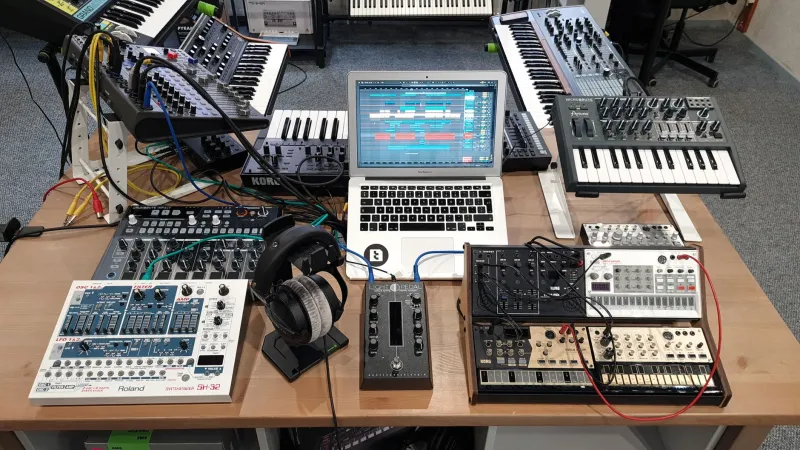
Let's be real: the first time you heard a Knife Party drop through a decent pair of headphones, some part of your brain went I want to make that. That feeling — equal parts awe and obsession — is where a lot of serious producers got their start. The good news is that the gap between your current setup and the tools Rob Swire and Gareth McGrillen use is smaller than you think. Not zero, but smaller.
This isn't a guide about faking it. It's about understanding the philosophy behind Knife Party's sound design and finding honest, affordable paths toward building something with that same kind of weight and intention.
Understanding the Philosophy First
Before you spend a dollar on new gear or plugins, spend time with the music. Knife Party's sound isn't just aggressive — it's architectural. Every element has a specific job. The bass doesn't just sit in the low end; it moves, morphs, and reacts to the arrangement around it. The synths aren't decorative; they're structural. The space between sounds is as deliberate as the sounds themselves.
If you go into production trying to copy individual sounds, you'll get surface-level results. If you go in trying to understand why each element behaves the way it does, you'll start building something that has the same internal logic — even if it sounds different on the surface.
"I spent six months trying to clone specific patches," said Marcus, a 24-year-old producer from Atlanta who has been reverse-engineering Knife Party tracks since high school. "Nothing clicked until I stopped asking 'what synth is this?' and started asking 'what is this sound doing to the track?' That shift changed everything."
The DAW Question
Knife Party has been associated with Ableton Live throughout most of their production history, and for bedroom producers, that's actually good news — Ableton's workflow is learnable, well-documented, and the Intro tier starts at a price point that won't empty your bank account. That said, FL Studio and Logic Pro X are both legitimate paths to the same destination. The DAW is a vehicle, not the destination.
If you're on a tight budget, FL Studio's one-time payment model is worth serious consideration. You buy it once, get lifetime updates, and the included plugin suite is deep enough to build professional-quality bass music without purchasing a single third-party tool.
The honest truth: the DAW matters less than how many hours you put into understanding it.
Synths That Punch Above Their Price
Knife Party's bass textures lean heavily on aggressive wavetable and FM synthesis. You don't need to spend hundreds of dollars to access both. Here's where budget producers should focus:
Vital (free/paid) — This wavetable synthesizer is genuinely extraordinary for a free-tier tool. The modulation routing is deep, the wavetable editor is intuitive, and it can produce the kind of gnarly, evolving bass sounds that define Knife Party's lower frequencies. The paid upgrade unlocks more presets, but the free version is production-ready.
Surge XT (free, open source) — An FM and wavetable hybrid with an intimidating interface that rewards patience. Once you understand its modulation matrix, you can build sounds with serious complexity. Multiple producers in online communities have documented Surge XT patches that get legitimately close to Knife Party-style aggression.
Serum (paid, ~$200 or rent-to-own) — If you're willing to invest, Xfer's Serum remains the industry standard for this style of sound design. The wavetable editor is the most visual and intuitive available, and the community has produced thousands of free presets specifically designed to chase that bass-forward electronic sound.
EQ and Compression: Where the Character Lives
This is where most bedroom producers leave serious quality on the table. Getting a synth patch to sound interesting is step one. Getting it to sit in a mix the way Knife Party's elements sit — with weight, clarity, and physical presence — requires understanding EQ and compression as shaping tools, not just corrective ones.
For bass textures specifically:
- High-pass everything that isn't intentionally occupying the sub-bass range. Mud kills impact.
- Use a mid-side EQ to widen upper harmonics of your bass while keeping the fundamental mono. This is one of the reasons Knife Party's low end translates so well on festival systems — it's wide in the mids but anchored in the center.
- Multiband compression on bass allows you to control the sub frequencies independently from the upper harmonics. This keeps the low end tight and punchy without squashing the character out of the higher overtones.
"The compression thing was a revelation," said Priya, a 21-year-old producer from Austin who started uploading Knife Party-influenced tracks to SoundCloud last year. "I was compressing my whole bass bus with one compressor and wondering why it sounded flat. Once I split it into bands, everything clicked into place."
Hardware on a Budget
You don't need hardware to make great music, but a few affordable pieces can significantly improve your workflow and output quality.
Audio Interface — A Focusrite Scarlett Solo or 2i2 will give you clean monitoring signal for under $130. Mixing on laptop speakers is a trap; even a cheap interface connected to budget studio monitors will reveal mix issues you can't hear otherwise.
MIDI Controller — A 25-key controller (Arturia MiniLab, Akai MPK Mini) gives you hands-on control over parameters that are tedious to automate with a mouse. For sound design work, being able to physically modulate cutoff or resonance while recording automation is a workflow accelerator.
Studio Monitors — Yamaha HS5s are a reliable entry point. If that's out of range, the PreSonus Eris 3.5 gives you a flat-ish response for under $100 a pair.
The Reverse-Engineering Method
The most valuable learning tool available to any aspiring producer is a track they already love. Load a Knife Party track into your DAW, drop it on a channel, and start building around it. Match the kick transient. Match the sub frequency. Match the way the bass moves through the drop.
You're not plagiarizing — you're studying. Every professional producer does some version of this. The goal isn't to release a clone; it's to understand the decisions well enough that your own work benefits from the same thinking.
"I rebuilt 'Centipede' from scratch three times," said Marcus. "By the third time, I wasn't trying to copy it anymore. I was just making something that had the same kind of energy. That's when I started finding my own sound."
The blade gets sharper with use. Start cutting.