Origin Stories: Tracing the Raw Ingredients Behind Knife Party's Most Devastating Tracks
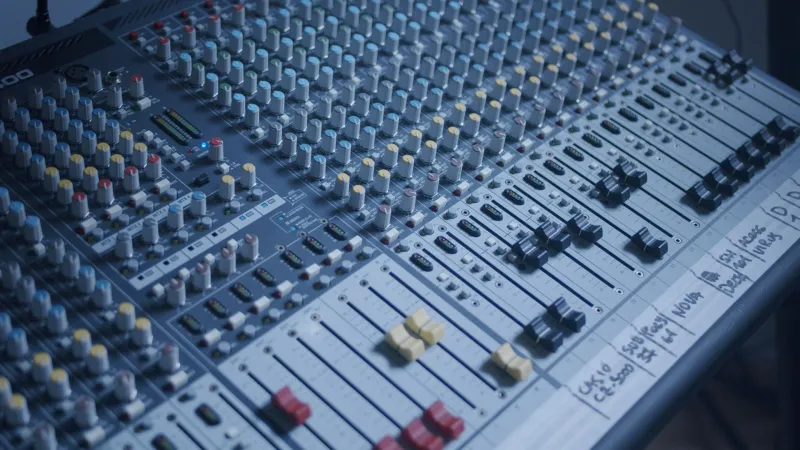
When a Knife Party drop lands, the last thing you're thinking about is where the sounds came from. You're thinking about the floor. You're thinking about whether your ribcage is going to survive the next four minutes. The forensics can wait.
But the forensics are worth doing. Because when you start pulling apart the sonic architecture of Knife Party's most iconic tracks — when you trace the samples, the vocal chops, the textural elements back to their sources — what you find is a production philosophy that's equal parts crate-digging and mad science. These tracks weren't assembled from a preset library. They were built from pieces of the world, processed until they were unrecognizable, and then weaponized.
Let's dig.
The Vocal Chop as Structural Element
One of the most recognizable signatures in Knife Party's toolkit is the chopped vocal — a snippet of sung or spoken audio, sliced, pitched, and rearranged until it functions less like a voice and more like a melodic percussion instrument.
This technique isn't unique to the duo, but the way they deploy it is distinctive. Where some producers use vocal chops as decoration, Knife Party tends to build around them. The chop becomes load-bearing. Remove it and the track loses its identity.
The sources for these elements are often deliberately obscure. Producers who've studied the duo's work closely describe a pattern of pulling from unexpected places — soul records, spoken word recordings, film dialogue — and processing the audio so aggressively that the original source becomes irrelevant. What matters isn't where the voice came from. What matters is what it does in context.
This approach has a long lineage in electronic music, stretching back through house, jungle, and early rave culture. But Knife Party's execution has a particular quality of violence to it — the chops feel cut with something sharp, not torn.
Industrial Noise as Texture
Listen closely to the space between the obvious elements in a Knife Party track — the moments that feel like negative space — and you'll often find something unexpected living there. Mechanical sounds. Metallic textures. Noise that doesn't have a clean musical identity but contributes to a sense of grit and physicality that purely synthesized elements can't always provide.
This is a production technique with roots in industrial music and noise art, genres that spent decades exploring how non-musical sound could be emotionally expressive. Knife Party didn't come up through those scenes directly, but the influence is audible. Their productions have a texture that feels lived-in, almost abrasive in places — a quality that separates them from the cleaner, more clinical aesthetic of a lot of mainstream EDM.
Finding these textural elements requires a different kind of ear than traditional sample hunting. You're not looking for a hook or a melody. You're looking for a sound that has the right weight, the right grain, the right amount of damage. It might come from recording a piece of industrial machinery. It might come from a field recording in a parking garage. It might come from an old piece of audio equipment being pushed past its limits.
Whatever the source, the goal is the same: to make the track feel real in a way that pure synthesis sometimes can't achieve.
The Video Game Connection
This one surprises people. But if you spend enough time with Knife Party's sonic palette — particularly the more aggressive, glitchy elements that appear in tracks like "Rage Valley" and several of the Haunted House EP cuts — you start to hear a relationship with video game audio design that goes beyond coincidence.
Early video game sound, particularly from the 8-bit and 16-bit eras, had a quality born of constraint: limited bit depth, restricted frequency ranges, sounds that had to communicate a lot with very little. That constraint created a kind of sonic efficiency that's genuinely useful in electronic music production. Every element has to work hard. Nothing is wasted.
Producers who've analyzed Knife Party's approach note a similar philosophy in how the duo handles their more percussive and glitch-oriented elements. There's an economy to it. The sounds are small but they punch above their weight, partly because they've been designed — whether consciously or not — with the same ruthless functionality as a sound effect that has to tell you something important in a quarter second.
Whether the duo was directly sampling game audio, drawing on those aesthetics as a reference, or simply arriving at similar solutions through similar problems, the relationship is there if you listen for it.
Synthesis as Archaeology
Not everything in a Knife Party track comes from an external source. A significant portion of their sonic vocabulary is synthesized from scratch — but the way they build those sounds often mirrors the process of sample archaeology.
Rather than starting with a preset and tweaking it, the approach tends to involve building sounds from basic waveforms and then processing them through chains of effects until they've accumulated the kind of character that a raw oscillator can't provide on its own. Distortion, saturation, filtering, modulation — layers of processing that add age and texture to something that was born clean.
This is synthesis as a form of found-sound work. You're not finding the sound in the world; you're finding it through a process of controlled damage. The result is a library of sounds that feel like they came from somewhere, even when they didn't — which is arguably more interesting than either pure synthesis or pure sampling.
What It All Adds Up To
The reason this matters — the reason tracing these sonic origins is worth the effort — is that it reveals something important about what Knife Party actually is as a creative entity.
They're not just beatmakers with good taste in drops. They're collagists. They're working in a tradition that treats the entire sonic world as raw material, that sees no meaningful distinction between a sample from a funk record and a sound recorded in a parking lot and a waveform built from scratch, as long as the end result serves the music.
That philosophy is part of what makes their tracks feel different from productions that rely more heavily on genre conventions and preset sounds. There's a specificity to the textures, a sense that these exact sounds couldn't have come from anywhere else, that they were chosen and shaped with a particular intention.
Pull the tracks apart, and what you find isn't a formula. It's a point of view. And that, ultimately, is what separates a Knife Party track from everything else in the room.