When Two Become One: The B2B Sets That Proved Knife Party Is Unstoppable Together
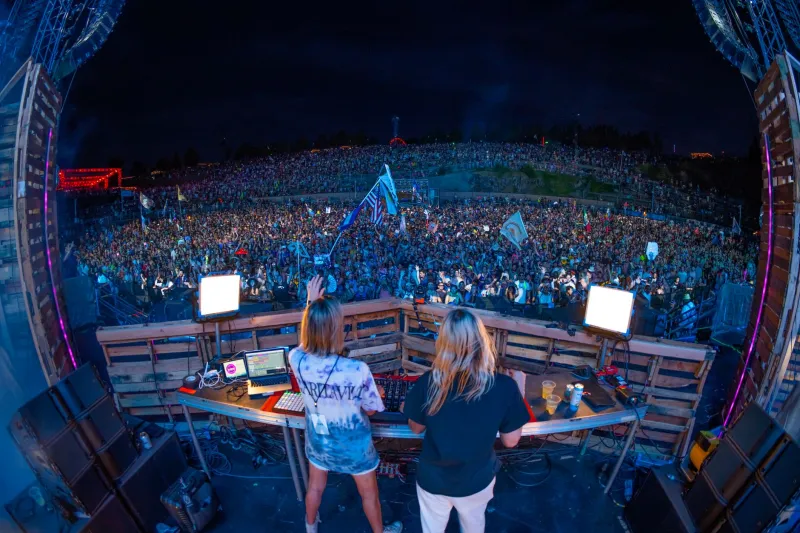
There's a particular kind of chaos that only happens when two people who know each other that well share a DJ booth. No handoff awkward silences. No polite transitions. Just two guys who've been finishing each other's musical sentences since their Pendulum days, throwing tracks at a crowd like they're daring each other to top the last move.
That's what a Knife Party B2B set looks like from the outside. From the inside — based on every fan account, bootleg recording, and social post we've collected over the years — it sounds like the floor is going to give out.
Rob Swire and Gareth McGrillen have been performing together so long that their back-to-back chemistry reads less like a tag-team format and more like a single organism with two brains running parallel processes. And when that organism gets behind a pair of CDJs in front of 10,000 people? Something genuinely different happens.
What Makes a B2B Set Different From a Standard Set
Before we get into specific moments, it's worth understanding why B2B sets hit differently in the first place. When a single DJ plays a set, they're executing a vision — a narrative arc they've largely pre-planned, with room for improvisation based on crowd response. It's a conversation between one artist and an audience.
A B2B blows that model up. Now you have two DJs responding to each other and the crowd simultaneously. The best B2B sets develop an internal momentum that neither player could generate alone — each track selection becomes a challenge to the other person, a kind of musical one-upmanship that audiences can feel even if they can't articulate it.
For Knife Party specifically, this dynamic is amplified by the fact that Rob and Gareth have genuinely different instincts behind the decks. Swire tends to lean into the tension — he'll hold a crowd at the edge of a drop longer than feels comfortable, building anticipation to an almost unbearable degree. McGrillen is more likely to pivot unexpectedly, dropping something no one in the room saw coming just when the energy feels like it's plateaued. Together, those two impulses create a push-pull that makes their B2B sets feel genuinely unpredictable even to people who've seen them perform dozens of times.
EDC Las Vegas 2014: The Night the Mainstage Remembered
If you ask fans who were at the Electric Daisy Carnival Las Vegas main stage in 2014 what the defining set of that weekend was, a significant chunk of them will say Knife Party — not just because the production was massive, but because of a specific sequence in the middle of their set that felt almost confrontational in the best possible way.
About 40 minutes in, after working the crowd through a run of their own material including "LRAD" and "Centipede," they pivoted into a stretch of tracks that had nothing to do with their own catalog. The move caught even seasoned fans off guard. Fan accounts from that night describe a collective moment of disorientation followed almost immediately by a surge in crowd energy — the kind of thing that happens when a DJ does something unexpected and the room realizes they're in genuinely capable hands.
What stood out to people who were there wasn't just the track selection but the speed of the transitions. In a B2B context, fast handoffs signal confidence and communication. The two of them were reading each other in real time, and the crowd could feel that synchronicity.
"I've seen a lot of sets at EDC over the years and the thing I remember about that one is that it never felt like they were sticking to a plan," recalls one fan who posts regularly in the Knife Party subreddit. "It felt like they were just reacting to each other and we were along for the ride."
The Club Circuit Moments That Never Got Filmed
Not every legendary B2B set happens on a main stage. Some of the most talked-about Knife Party shared-deck moments happened in smaller venues — warehouse shows, club residencies, and one-off events where the room capacity was measured in hundreds rather than thousands.
These sets tend to get discussed in hushed, almost reverent tones in fan communities because most of them were never properly recorded. You'll find fragments on YouTube, shaky phone footage where the audio is mostly distortion, but the full picture lives in the memories of the people who were physically present.
What fans consistently report from these smaller-room B2B sets is a different quality of experimentation. Without a massive festival audience to manage, Rob and Gareth apparently give themselves more permission to go weird. Deeper cuts, longer builds, tracks that wouldn't necessarily land in a 50,000-person field but absolutely destroy in a 500-person room where the bass frequencies have nowhere to go but through your chest.
One recurring theme in fan descriptions of these smaller sets: the moments where one of them clearly surprises the other. You can sometimes catch it in the footage that does exist — a slight head turn, a grin, the body language of someone who just got one-upped by their best friend and is already plotting the response.
Technical Decisions That Define the B2B Format
Beyond the track selection drama, there are technical elements to a Knife Party B2B that are worth appreciating if you care about DJ craft.
Their transitions in B2B contexts tend to be more abrupt than what you'd hear in a solo set — not sloppy, but deliberately sharp. It's a stylistic choice that reflects the energy of the format. In a B2B, seamless blending can actually work against you because it obscures the handoff moment, which is part of what the audience is responding to. Knife Party seems to understand this intuitively, using crisp cuts and precise drops to make each transition feel like a statement.
They also tend to play with tempo more aggressively in B2B settings. Sudden BPM shifts that would feel jarring in a traditional set become moments of collective surprise when executed cleanly in a B2B context — the crowd barely has time to register what happened before the new track has already taken hold.
Why the B2B Format Fits Knife Party Specifically
Here's the thing about Knife Party that makes their B2B chemistry make sense: they didn't start as a DJ duo. They came from Pendulum, a live band. The muscle memory for reading a room, responding to another performer, and building something collectively in real time was already deeply embedded before they ever touched a CDJ together.
That live performance DNA is visible in everything about how they approach shared-deck sets. The spontaneity doesn't feel like improvisation for its own sake — it feels like two musicians who trust each other enough to take risks because they know the other person will catch them if the move doesn't land.
For fans, that's exactly what makes a Knife Party B2B worth traveling for. You're not just watching a DJ set. You're watching a creative partnership play out in real time, under pressure, in front of a crowd that's ready to go absolutely sideways. And nine times out of ten, they deliver.